

The Aviator demo represents a critical training ground for one of the most popular crash-style aviator casino game variants online. This exhaustive whitepaper serves as a definitive resource, dissecting the demo’s mechanics to build a foundational understanding applicable to real-money play. Beyond simple gameplay, we will explore the mathematical engine, develop advanced strategic frameworks, and provide technical solutions for common issues, transforming you from a casual observer to an analytical player.
Before You Start: The Pre-Flight Checklist
Engaging with the aviator game demo effectively requires preparation. This checklist ensures you have the right mindset and tools.
- Understand the Core Concept: Aviator is a crash game. You place a bet before a round starts, watch a multiplier increase from 1.00x, and must cash out before it «crashes» at a random point to secure your winnings (bet x multiplier).
- Demo vs. Reality: The demo uses virtual credits. No financial risk exists, but the underlying Random Number Generator (RNG) and game logic are identical to the real aviator game online.
- Technical Readiness: Ensure a stable internet connection and an updated browser (Chrome, Firefox) or device if using a dedicated app. Disable ad-blockers if the demo fails to load.
- Goal Setting: Define your learning objective: Is it understanding volatility, testing a betting system, or mastering the user interface?
- Notation Tools: Have a notepad or spreadsheet ready to log round outcomes, multiplier crash points, and strategy performance.
Accessing and Navigating the Aviator Demo Environment
Unlike real-money versions, accessing the demo typically requires no registration. Navigate to the official game provider’s site or a partnered casino offering a free-play mode. The interface consists of:
- Multiplier Graph: The central visual where a line (aircraft) ascends, representing the growing multiplier.
- Betting Panel: Where you set your virtual bet amount and place the bet.
- Cash-Out Button: The manual control to lock in winnings at the current multiplier.
- Auto Cash-Out: A critical feature allowing you to pre-set a multiplier at which your bet is automatically cashed out.
- Round History: Displays the multipliers at which previous rounds crashed, often shown as a list or a chart.
Deconstructing the Mathematics: Probability and Expected Value
The aviator casino game operates on a provably fair system, typically using a client seed, server seed, and nonce to determine the crash point. The multiplier at which the game crashes (M) is derived from a uniformly distributed random number. The probability (P) of the multiplier reaching at least a value ‘X’ before crashing is approximately P = 1 / X. For example, the chance of reaching 2.00x is about 1/2 (50%), while reaching 10.00x is about 1/10 (10%).
Detailed Calculation Example (House Edge): Assume a bet of 100 virtual credits. If you set an auto cash-out at 2.00x, your probability of success is ~50%. Your expected return on a successful round is 100 credits * 2.00 = 200 credits. However, the game does not pay at true odds. If the fair odds for a 50% chance are 1:1, the game pays at 2.00x, which includes your stake. The expected value (EV) calculation per round is: EV = (Probability of Win * Net Profit) + (Probability of Loss * Loss). EV = (0.5 * (200-100)) + (0.5 * (-100)) = (0.5 * 100) + (0.5 * -100) = 0. This suggests a fair game, but in reality, the probability function is slightly skewed, and most implementations include a small house edge (e.g., 1-3%). For a crash point determined by P = (1 / X) * (1 – house_edge), the real probability of reaching 2.00x might be 0.495, not 0.5. This creates a negative EV for the player over time, a fundamental concept to grasp in the demo.
Advanced Strategic Frameworks for Demo Testing
The demo is the ideal venue to stress-test strategies without cost. Key methodologies include:
- Martingale Variants: Double your bet after a loss. In the demo, track how many consecutive losses your virtual bankroll can withstand before a win recovers losses. Calculate the required crash point multiplier for recovery.
- Reverse Martingale (Paroli): Increase bets after wins. Test its effectiveness in capturing «hot streaks» in the round history.
- Fixed Percentage Cash-Out: Always cash out at a fixed multiplier (e.g., 1.5x). Use the demo to gather data on the frequency of success and the long-term virtual balance trend.
- Pattern Reaction: Analyze the round history for apparent sequences (e.g., several low crashes followed by a high one). The demo allows you to practice reacting to these patterns, though remember each round is independent.
Scenario Analysis: Start a demo session with 10,000 virtual credits. Apply a strategy where you bet 100 credits per round with an auto cash-out at 1.8x. Log 100 rounds. Calculate your final balance, drawdown, and the highest multiplier that crashed before your cash-out point. This data is invaluable.
Technical Specifications and Game Data Table
| Specification | Detail | Notes for Demo Play |
|---|---|---|
| Game Type | Crash/Bet-on-Multiplier | Core mechanic identical to real money version. |
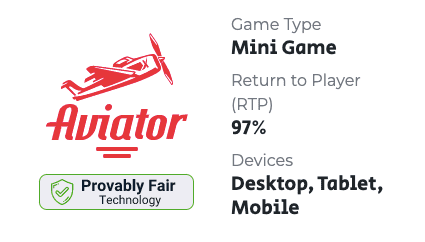
| Return to Player (RTP) | Typically 97-99% | Theoretical percentage over infinite plays; demo results will reflect this variance. |
| Volatility | Very High | Demo balance will experience extreme swings, perfect for risk assessment. |
| Key Determinant | Provably Fair RNG | Demo uses the same algorithm; verify fairness statements in game info. |
| Min/Max Bet (Demo) | Often 1 to Unlimited Virtual Credits | Allows testing of micro-staking and aggressive betting models. |
| Auto Cash-Out Range | Usually 1.10x to 1000x | Critical for strategy automation. Test limits. |
| Multiplier Precision | Two Decimal Places (e.g., 1.85x) | Affects cash-out timing granularity. |
| Round Duration | Variable, seconds to minutes | Demo helps gauge reaction time requirements. |
Security, Fairness, and Transition to Real Play
While the aviator game online demo involves no real funds, understanding the security framework is essential for future real-money play. Reputable demos are hosted by licensed providers (e.g., Curacao, Malta GAuthority) and use cryptographically secure RNGs. The provably fair system allows you to verify each round’s outcome by checking the hash of the server seed post-round. The demo is the place to learn how to access and interpret these fairness reports. Transitioning to real money involves recognizing the psychological shift—the mathematical edge remains constant, but emotional decision-making can introduce error.
Comprehensive Troubleshooting Scenarios
Even in a demo, technical issues can arise. Here are detailed scenarios and solutions.
- Scenario 1: Demo Game Fails to Load (Black Screen).
- Cause: Browser cache corruption, JavaScript conflict, or network firewall.
- Action: Clear your browser cache and cookies. Try a private/incognito window. Disable browser extensions one by one. Check if the site is blocked by your network administrator.
- Scenario 2: Gameplay is Laggy or Unresponsive.
- Cause: High latency connection, insufficient device resources, or server-side load.
- Action: Close other tabs and applications. Switch from Wi-Fi to a wired connection if possible. Restart your router. Try accessing the demo during off-peak hours.
- Scenario 3: Auto Cash-Out Function Not Triggering.
- Cause: User error (misconfiguration), game bug, or rapid crash before trigger.
- Action: In the demo, double-check the set multiplier. Test with an obvious value like 1.2x. If it consistently fails, report the bug to the provider. Note the round ID for reference.
- Scenario 4: Virtual Balance Not Resetting or Refreshing.
- Cause: Demo session persistence via browser local storage.
- Action: Manually refresh the page (F5). Look for a «Reset Balance» button in the game lobby. As a last resort, clear site-specific data in browser settings.
Extended Frequently Asked Questions (FAQ)
- Q: Is the Aviator demo truly random, or can I find a pattern?
A: The demo uses a cryptographically secure RNG designed to produce independent, unpredictable results. Any apparent patterns in short-term history are illusions of randomness. The demo’s purpose is to prove this to yourself through extensive logged play. - Q: Can I use the demo to practice for guaranteed wins in real money games?
A: No. No strategy can overcome the house edge in the long term. The demo helps you manage risk and discipline, not discover a winning formula. It teaches you how to lose less, not win consistently. - Q: What is the optimal auto cash-out multiplier to use in the demo?
A: There is no universal optimum. It depends on your risk tolerance. Mathematically, lower multipliers (e.g., 1.2x-1.5x) hit more frequently but offer smaller returns. Use the demo to find the balance where the frequency of success aligns with your virtual bankroll growth goals. - Q: How does the provably fair system work in the demo?
A: Before a round, the system generates a server seed hash. After the round, it reveals the server seed. You can combine this with your client seed (often a fixed value in demo) and the nonce (round number) to recalculate the crash point using a standard algorithm (like SHA-256), verifying it wasn’t altered. - Q: My demo round crashed instantly at 1.00x. Is this a bug?
A: No. The probability of a crash at 1.00x or very near it is low but finite (e.g., 0.01% chance). It is a valid, albeit rare, outcome. The demo confirms the game’s capacity for extreme volatility. - Q: Are there differences between demo versions on different websites?
A: Potentially, yes. Different casinos or aggregators might host slightly different builds from various developers (Spribe, etc.). The core gameplay is identical, but bet limits, interface skins, and bonus features may vary. Test multiple demos. - Q: Can I play the Aviator demo on my mobile device?
A: Absolutely. Most demos are HTML5-based and run directly in mobile browsers. Some casinos also offer dedicated apps. The touch interface for cash-out requires precise timing—practice in the demo is crucial. - Q: How many rounds should I play in the demo to properly test a strategy?
A: For statistically significant results, you need a large sample size. A minimum of 1,000 rounds is recommended to smooth out variance. The demo allows for this rapid, cost-free iteration. - Q: Does the demo simulate the same network latency as the real game?
A: Generally, yes, as it connects to the same game servers. Any latency experienced in the demo (e.g., delay between clicking cash-out and server confirmation) will be present in real play, making it critical for timing practice. - Q: What is the single most important lesson to learn from the Aviator demo?
A: Emotional control. The demo, despite using fake money, can trigger excitement or frustration. Mastering the discipline to follow a pre-set strategy despite virtual wins and losses is the key transferable skill to real-money aviator casino game play.
In conclusion, the aviator game demo is far more than a simple pastime. It is a sophisticated simulation laboratory. By methodically applying the principles outlined in this guide—from probability mathematics and strategic testing to technical troubleshooting—you build a robust analytical framework. This knowledge demystifies the game’s mechanics, instills disciplined habits, and ultimately leads to more informed and controlled engagement, whether you choose to remain in the demo environment or transition to the stakes-based arena of online play.